
A Public Company Goes All In on AI
What it means for other companies and their employees


Before the main story, a few headlines worth your attention.
Anthropic is scrambling to contain a leak of sensitive code tied to its Claude AI agent, raising concerns about intellectual property protection and model security. The incident underscores growing risks as AI systems become more complex and more valuable targets for leaks and reverse engineering. WSJ has the story.
OpenAI is expanding into media by acquiring TBPN, signaling a strategic push to directly influence how AI is understood by businesses and the public. This move positions OpenAI to shape industry narratives, strengthen brand authority, and guide enterprise adoption conversations. The NYT has the story.
Over-reliance on AI can erode critical human skills that underpin long-term competitive advantage. Companies must balance automation with deliberate investment in human expertise to avoid weakening their core capabilities as discussed in a recent HBR article.
AI is creating a governance gap at the board level, where adoption is accelerating but oversight and understanding lag. Boards need to move from passive supervision to active, AI-informed stewardship, defining their company’s AI posture and linking investments to business value. McKinsey has the details.
Gap is partnering with Google’s Gemini to let shoppers purchase within the AI interface, making it one of the first major fashion brands to enable in-chat checkout. The move signals a shift toward agentic commerce, where discovery, recommendation, and transactions all happen inside AI platforms. More at CNBC.
Why Fewer People Can Now Do More
What happens when a public company stops treating AI as a tool to enhance individual productivity and starts treating it as the operating system of the business. At Block, Inc., Jack Dorsey’s payments company, the answer was not incremental. It was structural, dramatic and maybe traumatic.
In a recent a16z conversation, Owen Jennings, Business Lead at Block describes a company that rebuilt itself around AI agents, internal tooling, and small, high-agency teams after reducing its workforce by roughly 40%. But the layoffs last month are not the story. The story is the assumption underneath them that teams of three can now do what once required fourteen. That assumption challenges a decades-old model of how companies scale.
For years, organizations grew by adding people, layers, and coordination. Hierarchy was the mechanism that made that possible. It routed information, enforced decisions, and maintained control in a world where human bandwidth was the constraint. AI changes that constraint.
When intelligence can synthesize information, route context, and assist in execution in real time, coordination itself becomes less dependent on people. And when coordination changes, the role of hierarchy changes with it.
Inside companies, coordination has always meant four things:
Translating strategy into tasks
Prioritizing what matters now
Synthesizing information across teams
Escalating decisions at the right moment
These were the hidden functions of program managers, project managers and team leads. AI is beginning to take on each of them. That is why layers start to feel optional.
What used to require meetings, approvals, and management oversight can increasingly be handled by systems that track context, generate options, and move work forward. Middle management gives way to smaller, more autonomous teams. Information flows are mediated less by people and more by machines. In effect, AI begins to take on the role hierarchy once played. But something important sits inside that shift.
Coordination was not just overhead. It carried judgment, context, and error correction. Remove it, and those protections weaken as well. Smaller, faster teams can move quickly, but they can also miss things more quickly. The question is not just whether AI can replace coordination (it can), but whether it can carry the judgment that coordination quietly embedded in the organization.
What Good Work and Talent Now Look Like
As coordination changes, so does the nature of work. Meetings built around presentations and documents are giving way to meetings built around prototypes. When the cost of building drops to near zero, the expectation shifts from explaining an idea to showing it and refining it in real time. The artifact becomes the conversation itself.
This accelerates decision-making and raises the bar. Whether it is a strategy, a campaign, or a product feature, teams are expected to produce something tangible early and iterate quickly because, after all, everyone can create with the AI tools. It also changes what talent looks like.
Roles centered on coordination, reporting, and process management become less central. In their place, the highest leverage comes from people who can build, prototype, and execute directly with AI.
The best teams are not larger. They are tighter, more autonomous, and able to turn intent into output quickly, without relying on layers of coordination or large groups of specialized contributors.
A typical sprint begins to look different. A small team defines the objective. AI generates initial approaches and produces a working prototype within hours. The team refines it in real time. There are fewer briefs, fewer handoffs, and fewer alignment meetings. Decisions happen against something concrete, not a document. This is where many organizations are stuck.
They are still structured for a world where coordination was expensive and slow, even as the tools they are adopting assume the opposite. Instead of redesigning how work happens, they are layering AI into existing workflows one tool at a time.
That approach will deliver incremental gains at best. It misses the larger opportunity.
For marketing organizations, the implications are immediate. The model built around briefs, handoffs, agency execution, and campaign cycles begins to break down. If ideas can be prototyped instantly, the brief loses its central role. If variations can be generated and tested in real time, campaign cycles compress. And if small teams can execute end-to-end, the need for large, distributed agency ecosystems diminishes.
The question is no longer how to optimize the current model. It is whether the model still makes sense.
The New Shape of the Company
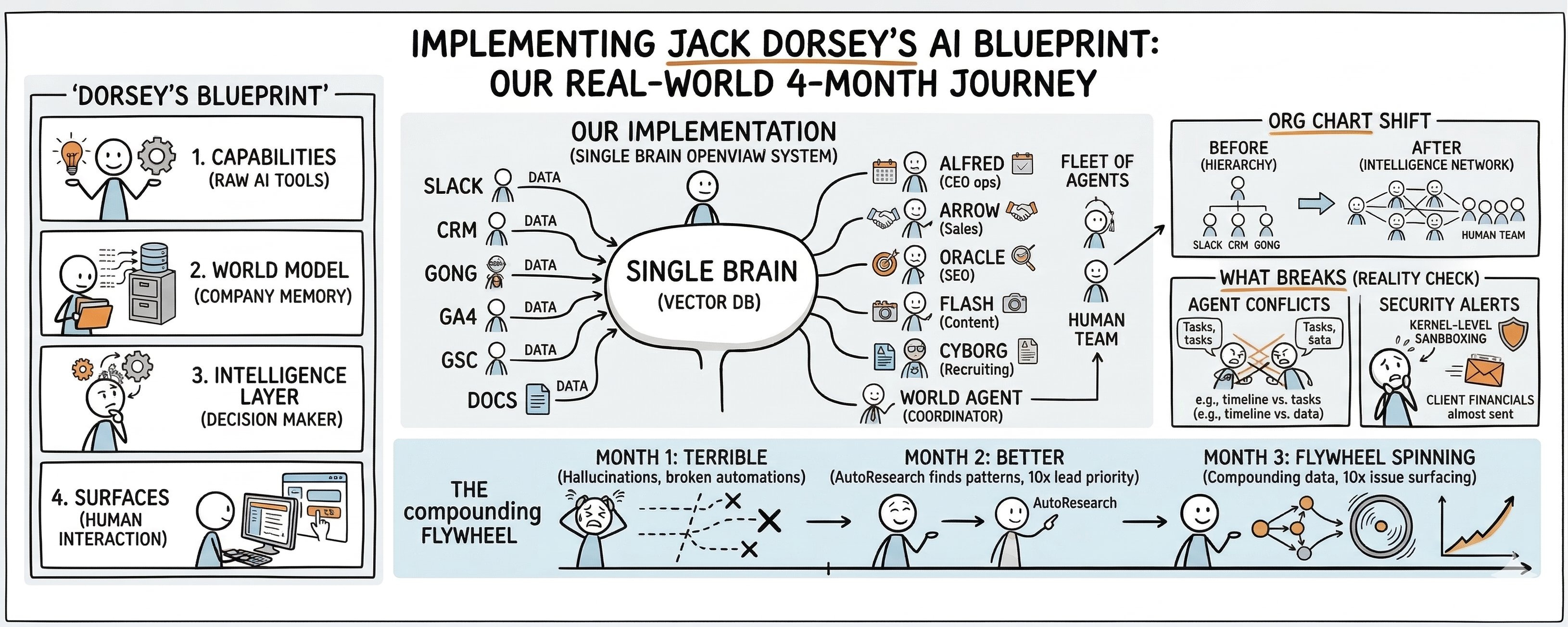
Block is not just applying this logic internally. It is extending it into its products.
At its Investor Day, the company outlined a vision for a more autonomous, customer-centered platform powered by proactive intelligence. Systems that do not just respond to input, but anticipate needs and act on behalf of the user.
The internal model and the external product are converging around the same idea: intelligence at the center, humans at the edge. That shift reframes how the company is understood.
It is no longer a collection of teams supported by tools. It is a system where humans, agents, and software operate together as a single fabric. The unit of execution is not the function or the department, but the small, high-agency team working alongside AI.
When a company begins to believe that one small team can replace four or five traditional teams, every assumption about headcount, structure, and scale starts to change.
None of this is without tension. Block over-hired in prior cycles (especially COVID), and there is pressure to improve margins. AI provides both a real capability shift and a narrative that supports restructuring. Both can be true. But the direction is clear.
Most organizations are still layering AI onto existing workflows in a siloed, tool-by-tool way. That approach will not hold. The real opportunity is to rethink how the entire function works: workflows, decision-making, bottlenecks, agency relationships, and where intelligence sits across the organization. The challenge becomes to rethink the workflows, make AI the operating system of the business and still have all the much needed checks and balances that every business requires.
Hierarchy was never sacred. It was simply the best available solution to the limits of human coordination. If those limits change, the design of the company can change with them. Block is one of the first public companies to act on that belief in a meaningful way. Others will follow. The question is not whether this model will emerge. It already is.
The question is whether you are redesigning your organization for it, or trying to fit AI into a structure built for a different era. One path leads to incremental gains. The other rewrites how the company works.
Where I’ll be
In less than a month, AI Trailblazers will host AI-Verse at POSSIBLE, one of the conference’s main stages dedicated entirely to AI. As North America’s largest marketing conference, POSSIBLE is the right place for AI Trailblazers community’s next serious, practical conversation about where AI is headed.
Built around the theme Show, Don’t Tell, the AI-Verse stage will explore the future of AI in business through a pragmatic, real-world lens, with a focus on what is working, what is changing fast, and what leaders need to understand now. It will feature more live experiences than any other stage.
Highly interactive and conversational, the stage builds on the momentum of our AI Trailblazers Winter Summit, which brought together an exceptional group of speakers and guests for a thoughtful, grounded exchange.bout the future of AI in business, and in marketing in particular.
Watch the video above to get a feel for the themes, ideas, and energy we’ll be building on at POSSIBLE. And see you at AI-Verse on April 27, 2026, at the POSSIBLE Summit in Miami!
What I’m reading
A 4 a.m. scramble turned a leak into a ‘workflow revelation’ (BI)
From Hierarchy to Intelligence (Sequoia Capital)
What I’ve written lately
AI Is Rewriting Who Decides (March 2025)
Fighting Cognitive Surrender (March 2025)
Who Remembers Wins (February 2025)
2025 AI Predictions: Identity & Agents (February 2025)
Claude Picked a Fight at the Super Bowl (February 2025)
Shiv Singh is the CEO of Savvy Matters, which helps business teams translate AI disruption into practical business and marketing strategies, organizational design, executive-ready roadmaps, and bespoke education programs. He is also the Co-Founder of AI Trailblazers, a vibrant community uniting marketers, technologists, entrepreneurs, and venture capitalists at the forefront of AI.
A former two-time Chief Marketing & Customer Experience Officer and author of Marketing with AI for Dummies (4th print run, translated into five languages), Shiv built his career at LendingTree, Visa, PepsiCo, and The Expedia Group, and serves as a public-company board member of a Fortune 300 company and private investor.