
Who Remembers Wins
Where your decision traces live may determine every marketer's career


A huge congratulations to the U.S. women’s ice hockey team on another gold, continuing their recent dominant Olympic run, and to the men’s team on their first Olympic gold since 1980. Sustained dominance, in sport or business, is rarely about a single breakthrough. It is about accumulated memory. And that is the theme of this week’s main story.
But before diving into the main story, here are a few headlines worth noting.
From Chatbots to Agents when AI Does the Work: In Ezra Klein’s conversation with Anthropic co-founder Jack Clark, the through line is clear. We are rapidly moving beyond the chatbot era into an agentic one, where AI systems can execute multi step tasks and integrate into real workflows, with tools like Claude Code serving as the catalyst. The focus shifts from flashy demos to business impact, as agents take on the glue work inside organizations and raise urgent questions about how quickly that usage translates into productivity gains and job displacement, and whether policy, interpretability and human oversight can keep pace if economic effects arrive faster than institutions are prepared. Read the important interview.
The AI OS Wars now has four players, all chasing the same prize: owning the workflow layer. Google is pushing Gemini for Workspace as an enterprise productivity engine, deeper in Docs, Sheets, Slides, and Gmail, with stronger admin controls and guardrails for scaled rollout. Microsoft is positioning Copilot as the operating layer across Microsoft 365, with tighter governance and more connectors so it can pull context and take action. OpenAI is selling Frontier, an enterprise agent platform to build, manage, and permission fleets of AI agents across tools. Anthropic is moving Claude from answering to doing, with new customizable connectors and workflows that let teams automate real work inside their existing systems. The question is who will win the contextual layer
AI becomes the org chart: Block, with Jack Dorsey at its helm, announced it will cut roughly 40% of its workforce, more than 4,000 roles, and it is explicitly tying the move to AI. Dorsey argues that intelligence tools have changed what it means to build and run a company, and he says the constraint now is an application gap in how teams deploy the models, not the models themselves. He pointed to a December inflection point when he realized how capable the latest systems had become, effectively framing AI as a baseline operating layer rather than an innovation initiative. Block reported $6.25B in Q4 revenue, and the stock jumped more than 20% in after-hours trading. Read more in The Wall Street Journal.
AI Is Raising the Bar for Revenue-Accountable CMOs: CMOs are being pulled decisively toward measurable growth. A NewtonX survey for Adweek found that 48 percent now rank revenue growth as their top priority, compared with 24 percent who prioritize long term brand awareness. AI is accelerating this shift. As automation makes it easier to produce more marketing, leadership is demanding proof that it drives pipeline and sales rather than just impressions, pushing CMOs to connect AI enabled speed and scale directly to business outcomes. These findings jive with what we’re seeing in our own client work.
The Missing Layer in Marketing
Imagine this scenario. It is February, and a CPG brand’s marketing team is planning a fall campaign. The new head of growth proposes a TikTok-first strategy targeting Gen Z. It sounds right. The data supports it. The AI copilot drafts the brief in minutes. The cross-functional team is already spitballing ideas on slack and is speed dialing its agencies.
What nobody in the room remembers is that two years ago, the same brand ran a nearly identical campaign. It underperformed, not because the targeting, influencer strategy or creative was wrong, but because legal flagged a regulatory constraint on health claims in short form video that forced a last minute creative pivot. The campaign launched late and half formed, and the post mortem was buried in a Slack thread that no longer surfaces in search. The team has since turned over, so the lesson never carried forward.

The AI copilot does not know this. The CRM does not know this. The media platform does not know this. The brand team is new, and the agency is new too. No one is digging through forgotten folders to find old recap decks. The institutional memory of why that decision failed lives nowhere retrievable. The team is about to make the same mistake again. This is not a tooling problem. It is a memory architecture problem.
This is the gap that will define the next era of marketing. Not the brand layer. Not the AI generation layer. Not the analytics layer. The context graph layer.
What a Context Graph Actually Is
A context graph is institutional memory rendered as structured data. It captures not just what happened, but the reasoning and precedent behind what happened. It is the system that records decision traces, the connective record of how and why decisions get made across systems, not just the final outputs those systems store.
This idea is gaining real traction in Silicon Valley. Friends at companies like Foundation Capital, Box, and at startups like Instalily and Glean, are defining, framing and then also turning this concept into real practice. The argument is that we have spent two decades building systems of record, CRM, ERP, marketing automation, analytics. What we have not built is a system of reasoning that’s founded on the actual tribal knowledge within organizations.
Most enterprise systems, including marketing oriented ones, are excellent at recording outcomes. They log the approved budget, final copy, campaign ID, spend levels, conversion rates, top performing creative, and downstream results. What they rarely capture in structured form is the reasoning. Why the decision was made. What alternatives were considered. Who influenced it. What constraint shaped it. Which external event triggered it. In other words, the context graph and the context layer are missing.
Foundation Capital makes an important distinction here. Capturing the pure why may be difficult, but capturing the how is entirely feasible. Which policies were applied. Which documents were consulted. Which approvals were required. Which exceptions were granted. Which meetings captured those decisions. Over time, those traces allow systems to infer the underlying logic behind decisions. That is the beginning of institutional memory as software, replacing the manual connective tissue that so far has lived in conversations, inboxes, and human memory that simply fades away.
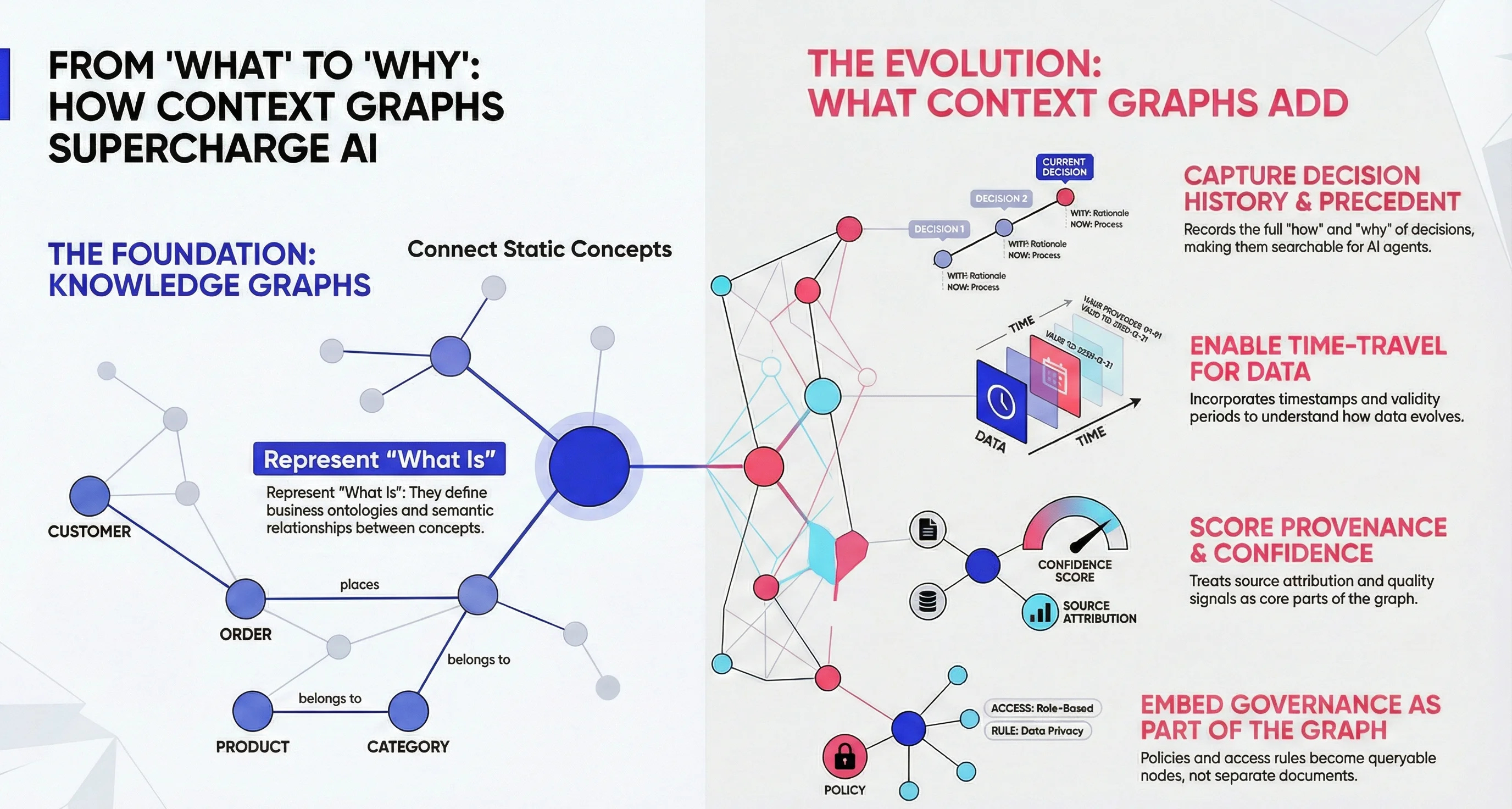
Over time, those missing elements accumulate into tribal knowledge. The scar tissue. The unwritten rules. The CEO’s preferences about brand voice. Legal red lines in regulated categories that determine whether certain creative ideas make it out the door or get left on the cutting room floor. The real reason a campaign failed that no dashboard can surface.
In marketing, this matters more than almost anywhere else. Decisions sit at the intersection of brand, growth, finance, product, legal, and culture. They are cross functional and event driven. If you do not capture decision traces at the moment they happen, you cannot reconstruct them later with fidelity. Without that continuity, AI systems will optimize locally based on visible outputs while drifting strategically. And human teams, like that CPG marketing group (if AI is not part of the equation), repeat avoidable mistakes because the history of decisions is not structurally retrievable. They miss a critical feedback loop that would normally compound in value over time.
The context graph is the connective tissue between what your organization’s tribal knowledge and what your AI agents and human teams can actually use. For the first time, the technology exists to build it.
Getting it right: Three Paths, One Real Choice
As a result, the most consequential marketing technology decision this year is not another point solution for a specific sub-function in marketing. It is where your context graph layer lives and marketing orchestration happens. The system that sits above the stack, coordinates workflows, and captures decision traces as work happens.
That layer must integrate CRM data, media performance, customer insights, strategy inputs, your CDP, and historical, artifacts of all kinds. But more importantly, it must sit in the execution path so that reasoning and decisioning are captured as a byproduct of workflow, not as an afterthought.
Marketing leaders effectively face three paths as they upgrade their marketing technology stacks to take advantage of what maybe their most consequential decision this year.
The marketing AI platform. Tools like Copy.ai, Jasper, and Writer, are expanding beyond text and image generation toward brand memory, governance, workflow, agent building and knowledge grounding. Their advantage is fluency in how marketing actually works. The risk is isolation from broader martech and enterprise AI infrastructure.
The workflow backbone. Platforms like Adobe Workfront and Monday.com already manage briefs, approvals, and resource allocation. They contain fragments of decision flow, even if they were not designed to capture rich rationale. Extending them into a true contextual layer would require a structural evolution of what workflow software means.
The enterprise AI platform. Many CTOs and CIOs are standardizing on a centralized AI provider. Consolidation reduces risk and simplifies governance across the enterprise. The advantage is alignment and security. The risk is that a general purpose platform may never develop the marketing specific context awareness required for a high fidelity context graph.
Each path has strengths. But this is not a feature comparison exercise. It is a structural decision about where institutional memory will live and who will own it.
Most importantly, bringing in a few vendors and testing them on a handful of use cases pitched to a specific marketing sub-function will not get you to a holistic contextual layer that can stand the test of time.
You need to approach strategy, architecture design, vendor assessment, and onboarding far more strategically and holistically, not in a piecemeal, one-pilot-at-a-time fashion, with deep AI expertise at the table, than you may have had for any previous martech investments. That’s the only choice.
The Lock In Problem Is Structural
A context graph only becomes powerful when it compounds over time. It must observe patterns across planning cycles, reallocations, launches, campaigns, experiments, and crises. It must learn how tradeoffs get resolved and how strategy evolves. As a result, the lock in is not contractual. It is an architectural choice.
Decision traces are relational. This decision was shaped by that constraint, informed by that precedent, influenced by that stakeholder, triggered by that event. Flatten those relationships and you lose meaning. A decision trace without relational context is just another log entry.
If reasoning is captured in one system this quarter, another the next, and partially in a third because teams prefer different AI tools, the graph fractures. Precedent becomes unsearchable. Context becomes stranded. Agents operate on partial memory.
That is why the contextual layer must sit in the path of work. It must be where briefs are written, budgets approved, copy generated, tests launched, and pivots executed. And it must remain there long enough for decision traces to compound. It is also why it is not another simple workflow platform decision or another tool to experiment with in a sandbox. Those marketers that think about it that way may miss the point.
The Strategic Bet
No single platform today is fully built to serve as the system of record for judgment across brand, growth, finance, product, legal, and culture simultaneously. That is precisely why the decision is strategic.
You are not choosing a finished product. You are choosing the foundation you are willing to build on. The worst outcome is not choosing imperfectly. It is allowing fragmentation to persist while AI agents proliferate on top of incomplete context.
In a world where models commoditize and execution becomes table stakes, durable advantage will not come from who generates faster.
It will come from who remembers better.
The organization that centralizes its decision traces, commits to a coherent context layer, and allows it to mature over time will not just move faster. It will move with memory and avoid repeating mistakes, like the CPG marketing team was on the cusp of doing.
Where I’ve been
I recently attended Virtuosi League’s Industry Leader Forum in Carmel Valley, a curated gathering of executive leaders across the marketing industry focused on the forces reshaping our profession. As a member of the steering committee, I joined Mark Kirkham of PepsiCo, Josh Spanier of Google, and Rebecca Messina of McKinsey to lead the Human and Machine working group conversation. Here are a few photographs from the inspiring and thought provoking forum.


What I’m reading
InstaLILY: Giving companies the power of two AIs (Google DeepMind)
AI Coding Tools for Knowledge Work (MIT Sloan Review)
Nano Banana 2: Combining Pro capabilities (Google Blog)
What I’ve written lately
Claude Picked a Fight at the Super Bowl (February 2025)
AI Everywhere, Wisdom Nowhere (January 2025)
Authenticity is Dead (January 2025)
The Wrong Code Red (December 2025)
Shiv Singh is a C-suite advisor and CEO of Savvy Matters, helping business teams translate AI disruption into practical business and marketing strategies, organizational design, executive-ready roadmaps, and bespoke education programs. He is also the Co-Founder of AI Trailblazers, a vibrant community uniting marketers, technologists, entrepreneurs, and venture capitalists at the forefront of AI.
A former two-time Chief Marketing Officer and author of Marketing with AI for Dummies (4th print run, translated into five languages), he built his career at LendingTree, Visa, PepsiCo, and The Expedia Group, and serves as a public-company board member of a Fortune 300 company and private investor.